
iPhone Fold: Release Date, Price & Specs Explained
iPhone Fold: Release Date, Price & Specs Explained
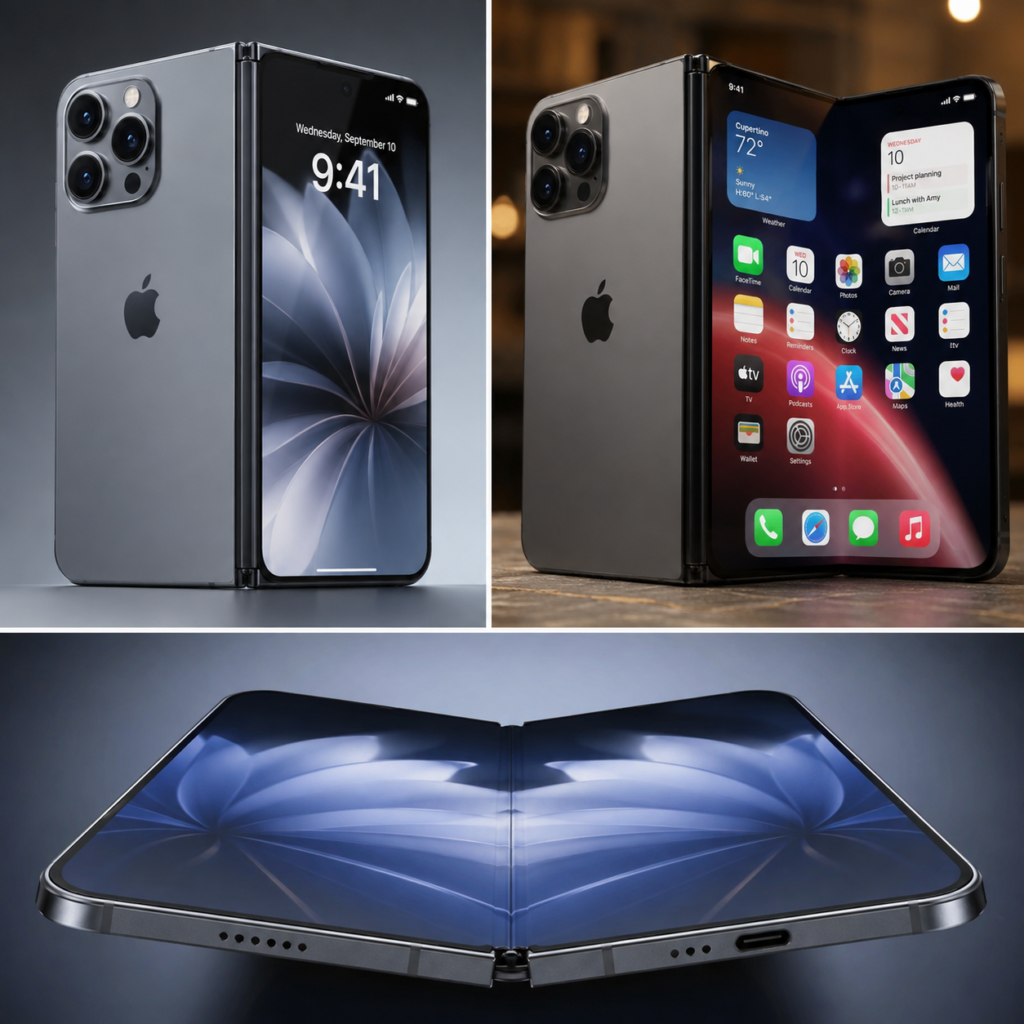
Apple has patented folding phone designs since 2016. That’s not a typo — a full decade of patents, prototypes, and “it’s finally coming next year” headlines that never quite materialized. This year, for the first time, the rumor trail actually looks different: real supply chain production numbers, leaked internal specs, and reporting from Apple’s most reliable sources all converging on the same conclusion. The iPhone Fold release date and price are finally coming into focus, and it looks like 2026 really is the year it happens.
Please choose display type!We’ve already covered the broader iPhone 18 lineup in our complete rumor roundup and gone deep on the rumored variable-aperture camera — this article is dedicated entirely to Apple’s first foldable, because it deserves its own deep dive. Let’s get into everything currently known.
What Is It Actually Called?
Even the name isn’t settled yet, which tells you a lot about how early-stage this still is. Tech media largely settled on calling it the iPhone Fold early in the rumor cycle, and it remains the most commonly searched term. But multiple credible leakers — including a well-known source on Weibo and Bloomberg’s Mark Gurman — have suggested Apple may actually brand it the iPhone Ultra instead, positioning it as a flagship tier name rather than simply describing its form factor. You’ll also see it referred to online as “iPhone Ultra Fold,” a combination some outlets use when hedging between the two possibilities.
For this article, we’ll use “iPhone Fold” throughout since it’s the more widely recognized term, but know that Apple could reveal a completely different name at the actual event.
When Is It Actually Launching?
The most consistent piece of this puzzle: a September 2026 launch, arriving alongside the iPhone 18 Pro and Pro Max as part of the same event. Multiple independent analysts and supply chain reports have converged on this window.
That said, there’s a real possibility of a gap between announcement and availability. Some reports suggest mass production wasn’t expected to begin until August 2026, which is unusually late and tight for a September reveal — raising the possibility that Apple announces the device in September but doesn’t actually ship it to customers until October or even later in the year. If you’re planning to buy on day one, this is worth watching closely as the date approaches, since a delayed shipping window wouldn’t be unprecedented for a genuinely new Apple product category.
The Price: Apple’s Most Expensive iPhone Ever
Let’s address this directly, because it’s the detail generating the most reaction. Pricing estimates have shifted around over the past year and a half, but they’ve consistently landed in expensive territory:
- Early 2025 analyst estimates suggested a range between $2,000 and $2,500
- A mid-2025 leak narrowed that to roughly $2,100–$2,300
- More recent reporting from a JPMorgan analyst, cited via CNBC, pointed to a starting price of exactly $1,999
- Higher storage configurations (512GB, 1TB, and potentially 2TB) are expected to push meaningfully higher, with some estimates reaching as high as $2,800–$2,900 for top-tier storage
Whatever the exact starting number ends up being, one thing is now essentially certain across every source: this will be the most expensive iPhone Apple has ever sold, likely by a wide margin over the current iPhone 17 Pro Max.
For context, that starting price would sit noticeably above Samsung’s Galaxy Z Fold8, which launched at $1,899, and its more premium Z Fold8 Ultra variant at $2,099. If the rumors hold, Apple wouldn’t just be entering the foldable market — it would be entering at the very top of it, price-wise.
Design: A Different Shape Than You’d Expect
If you’re picturing a taller, narrower version of a Galaxy Z Fold, the current rumors suggest something different. Apple’s foldable is expected to open into a notably wide, almost iPad mini-like shape — a roughly 4:3 aspect ratio rather than the taller, narrower proportions Samsung’s foldables use. Some reporting describes it as closer in shape to the original Google Pixel Fold than to Samsung’s design, which would give it a wider landscape view — genuinely better suited to watching video without the letterboxing that narrower foldables suffer from.
Display sizes: The most consistently repeated figures are a roughly 7.8-inch inner display and a 5.5-inch outer display, though a few reports suggest slightly smaller variations (7.6 inches inner, 5.3 inches outer) depending on the source.
Thickness: This is where things get genuinely impressive, if accurate. Estimates suggest the device could measure just 4.5 to 4.8mm thick when unfolded — thinner than Apple’s own iPad Pro — and somewhere around 9 to 9.5mm when folded closed. Worth noting though: Samsung’s newly launched Galaxy Z Fold8 Ultra reportedly measures 4.1mm unfolded, which would actually make it thinner than Apple’s rumored foldable, despite Apple’s reputation for obsessing over thinness.
Materials: Reports point to a titanium-and-aluminum body, with some sources specifically mentioning a liquid metal hinge — a material choice reportedly stronger than titanium alone, aimed squarely at the durability concerns that have plagued foldable phones since the category began.
The Crease Question: Apple’s Biggest Engineering Bet
If there’s one feature the rumor mill keeps circling back to, it’s this: Apple is reportedly determined to eliminate the visible crease down the middle of the inner display — the single most common complaint about every foldable phone on the market today, Apple’s competitors included.
Reports describe this as a top engineering priority for Apple, with the company reportedly willing to accept significant cost increases to solve it properly rather than ship a compromised version. Multiple sources point to Samsung Display as the manufacturer behind the panel, reportedly under a multi-year exclusive supply deal, using a new hinge and layer-stack design specifically engineered to reduce crease visibility. Worth being precise here though: more recent reporting suggests the result may be better described as a dramatically reduced crease rather than a completely invisible one — still a meaningful engineering achievement, just not quite the flawless “no crease at all” some earlier rumors promised.
If Apple pulls this off even partially, it could set a new bar for the entire foldable category — this is one of the most-cited reasons analysts expect competitors to respond quickly once Apple’s version ships.
The Trade-Off Nobody Expected: No Face ID
Here’s a genuine surprise buried in the leaks, and one worth knowing before you get too attached to the idea of this device: multiple independent sources agree the iPhone Fold will not include Face ID.
Apple’s reported reasoning comes down to physical space — fitting the necessary Face ID sensor hardware into two separate locations (one for the outer display, one for the inner) inside a chassis this thin proved to be too much of a squeeze. Instead, the device is expected to bring back Touch ID, integrated directly into the power button — the same approach Apple already uses on the iPad Air and iPad mini.
For anyone who’s used an iPad with power-button Touch ID, this isn’t necessarily a downgrade in practice — it’s fast and reliable. But it is a genuine departure from how every mainline iPhone has worked since the iPhone X, and worth factoring into your expectations if Face ID integration matters to your workflow (Face ID-gated banking apps, certain security features, etc.).
Cameras: Solid, Not Pro-Level
Don’t expect this to match the camera capability of the iPhone 18 Pro Max. Reports consistently describe a dual rear camera system, both at 48MP — a solid, capable setup, but notably absent a telephoto lens, meaning no dedicated optical zoom the way the Pro lineup offers. This tracks with how Apple has historically approached genuinely new product categories: prioritize getting the core experience right in generation one, and save the most advanced camera hardware for the following year once the format is proven.
Chip, RAM, and Connectivity
Under the hood, the iPhone Fold is expected to run on the same A20 chip family powering the rest of the 2026 lineup, paired with 12GB of RAM — enough to comfortably handle the multitasking-heavy use case a larger foldable display is specifically built for. Connectivity is expected to include Apple’s next-generation C2 modem, the company’s own in-house cellular chip, continuing Apple’s push away from third-party modem suppliers.
Software: A New Way of Using iOS
A foldable this size isn’t just a bigger screen — it fundamentally changes how the software needs to behave. Hints have already surfaced in iOS 27 developer beta code pointing to native support for a “folded state” and multiple viewing angles, suggesting Apple has been building foldable-specific software behavior well ahead of the actual hardware reveal. Apple has also referenced a concept called “app adaptability” — essentially ensuring apps can intelligently resize and reflow between the compact outer display and the much larger inner display, rather than simply stretching a phone-sized interface awkwardly across a tablet-sized screen.
This is genuinely one of the bigger open questions heading into launch: foldables live or die on how well third-party apps actually adapt, not just how good the hardware is. Samsung has spent years refining this on Android; Apple is starting fresh on iOS specifically for this form factor.
iPhone Fold vs. the Competition
Here’s how the rumored iPhone Fold stacks up against the foldables already on the market today:
| Spec | iPhone Fold (Rumored) | Samsung Galaxy Z Fold8 Ultra | Samsung Galaxy Z Fold8 |
|---|---|---|---|
| Starting Price | ~$1,999+ | $2,099 | $1,899 |
| Unfolded Thickness | ~4.5-4.8mm | 4.1mm | Not specified |
| Inner Display | ~7.8″ | Similar class | Wide/passport-style |
| Authentication | Touch ID (no Face ID) | Face ID equivalent | Face ID equivalent |
| Status | Rumored, Sept 2026 | Available now | Available now |
The honest takeaway from this comparison: Apple isn’t rumored to be undercutting the competition on price or beating them on raw thinness. Its case for a premium over Samsung’s already-available foldables rests almost entirely on the crease-reduction engineering and the broader iOS ecosystem integration — not on outright spec superiority.
Should You Actually Wait for This, or Buy Something Else?
Being honest about this the way we try to be with every rumor-based post: a first-generation foldable from any company, Apple included, comes with real trade-offs beyond just the eye-watering price.
Reasons to consider waiting for it:
- You’re deeply invested in the Apple ecosystem and specifically want a larger-screen iPhone experience for multitasking, reading, or media
- The idea of a crease-free (or significantly reduced-crease) foldable display genuinely excites you
- You don’t mind paying an early-adopter premium for genuinely new hardware
Reasons to think twice:
- No Face ID may be a real limitation depending on which apps and security features you rely on daily
- No telephoto camera means a real step down in zoom capability compared to a Pro model
- First-generation hardware — from any manufacturer — tends to carry unresolved long-term durability questions that only reveal themselves after a year or two of real-world folding
- At $1,999+, this will likely cost more than an iPhone 18 Pro Max and a second device combined
If the foldable form factor itself isn’t the specific draw for you, the current iPhone 17 Pro Max remains an excellent, proven phone today — we broke down exactly how it compares to the rest of this year’s flagship field in our best smartphones over $800 guide.
Frequently Asked Questions
When will the iPhone Fold be released? Current rumors point to a September 2026 announcement alongside the iPhone 18 Pro and Pro Max, though actual availability could slip into October or later due to reportedly tight manufacturing timelines.
How much will the iPhone Fold cost? Estimates have varied, but recent analyst reporting points to a starting price around $1,999 for the base storage configuration, with higher storage tiers potentially reaching $2,800 or more. It will almost certainly be the most expensive iPhone Apple has ever released.
Will the iPhone Fold have Face ID? No — multiple sources agree the device will use Touch ID integrated into the power button instead, similar to the iPad Air and iPad mini, due to space constraints from fitting Face ID hardware into both the outer and inner display sections.
Will the display really have no crease? Early rumors suggested a fully crease-free display, but more recent, more specific reporting suggests Apple’s engineering significantly reduces the crease rather than eliminating it completely. Either way, it’s expected to be a meaningful improvement over current foldables on the market.
Is the iPhone Fold worth buying over a Samsung Galaxy Z Fold8? It depends entirely on your priorities. Samsung’s foldables are already available, proven, and generally less expensive. Apple’s foldable is expected to offer superior crease reduction and iOS ecosystem integration, but at a higher price and without a telephoto camera or Face ID — a genuine trade-off rather than a clear upgrade in every category.
What will Apple actually call it — iPhone Fold or iPhone Ultra? This remains unconfirmed. “iPhone Fold” is the more commonly used term in coverage so far, but several credible leakers, including Bloomberg’s Mark Gurman, have suggested Apple may go with “iPhone Ultra” as the official name instead.
The Bottom Line
After the better part of a decade of rumors that never quite panned out, the iPhone Fold finally feels like a real, imminent product rather than permanent vaporware — but it’s shaping up to be a genuinely unconventional first move for Apple. No Face ID, no telephoto lens, and a price tag that will make it the most expensive iPhone ever sold are not small trade-offs, even wrapped in genuinely impressive engineering around thinness and crease reduction.
Whether it’s worth the premium will likely come down to one simple question once real reviews land: does the larger, near-crease-free display change how you actually use your phone day to day, or is it a novelty you stop noticing after the first week? We’ll be updating this post as more details emerge and, eventually, once Apple actually confirms the device at its September event.
This article is based on current rumors and industry reporting as of August 2026. Nothing here is officially confirmed by Apple, and details may change before the actual announcement.
