
iPhone 18 Price Predictions (2026)
For years, Apple’s pricing was one of the most boring, predictable parts of any iPhone launch — the base Pro model sat at $999 for so long it practically became a law of nature. That streak looks like it’s finally ending. Every major analyst covering Apple right now is converging on the same basic conclusion: iPhone 18 price predictions point to a real increase this year, not just internet speculation — the actual disagreement is over how big that increase will be, not whether it’s happening at all.
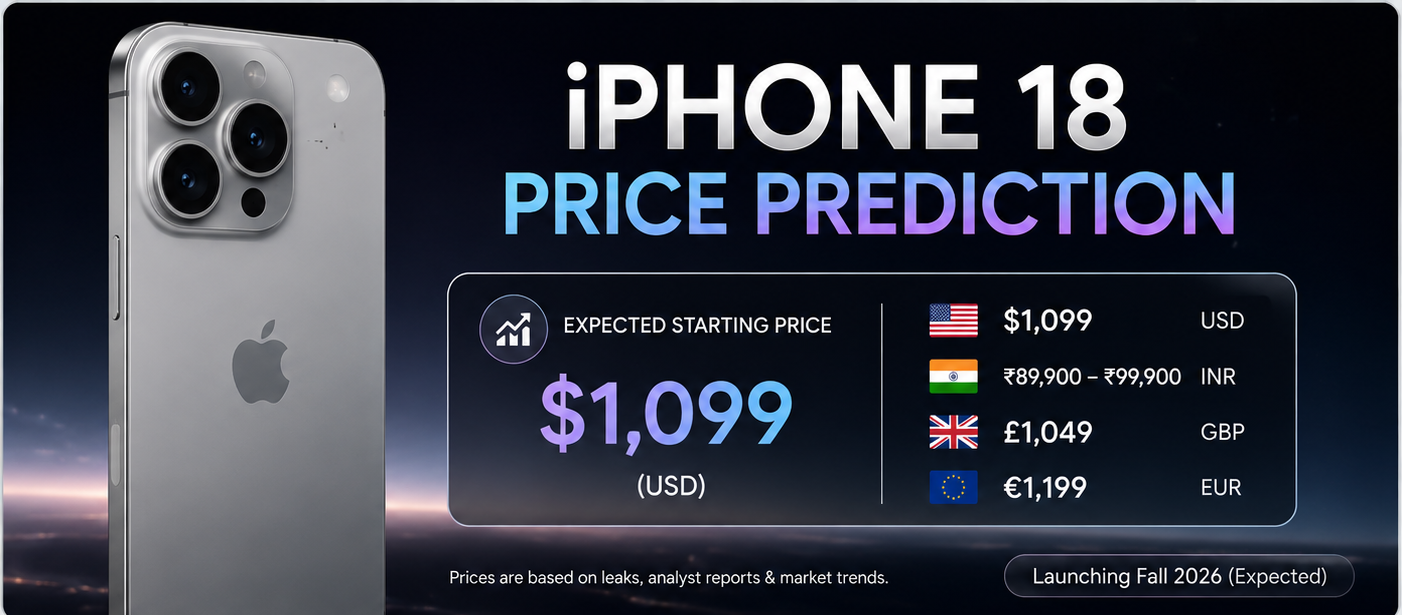
We’ve already covered the release date, camera, colors, and foldable rumors in our other iPhone 18 coverage — this one is dedicated entirely to the number that decides whether you’re actually buying one. Let’s walk through exactly what every major source is predicting, and why.
The Short Version
Every credible estimate currently places the iPhone 18 Pro somewhere between $1,049 and $1,399 — up from the current iPhone 17 Pro’s $1,099 starting price (an already-adjusted figure; older base models sat at $999 for years before that). The most commonly cited, middle-of-the-road figure across multiple analysts lands around $1,299 for the Pro, with the Pro Max pushing toward $1,349–$1,399. The first-ever foldable iPhone is expected to launch well above $2,000, regardless of how the Pro pricing shakes out.
Now let’s get into exactly where these numbers come from, because it matters — not every prediction carries the same weight.
Why Prices Are Actually Expected to Rise This Year
Unlike some past rumor cycles where “iPhone getting more expensive” was more clickbait than substance, this year’s case is unusually well-supported by real, verifiable cost pressures:
Memory and component costs have genuinely spiked. A global surge in AI infrastructure spending has driven demand for memory chips (DRAM and NAND) sharply upward, and Apple sources the same memory market every other device manufacturer competes for. Several Android manufacturers have already raised their own prices in response to this exact pressure — this isn’t an Apple-specific rumor, it’s an industry-wide supply chain reality Apple can’t fully avoid.
The variable-aperture camera adds real cost. According to supply chain analyst Ming-Chi Kuo — one of the most consistently reliable sources on Apple’s component costs — the rumored variable-aperture camera system for the iPhone 18 Pro costs roughly 50% more than the current lens assembly. We covered this feature in full in our variable aperture camera deep dive, but the pricing angle is worth repeating here: a meaningfully more expensive component has to show up somewhere in the final price.
RAM is increasing across the board. Reports indicate the iPhone 18 Pro models will ship with 12GB of RAM, and even the standard iPhone 18 — not expected until spring 2027 — is rumored to jump to 12GB from the iPhone 17’s 8GB. More memory means more cost per unit, even before accounting for the current memory price spike.
Apple already raised prices elsewhere. In June 2026, Apple increased prices on iPads, Macs, HomePods, the Apple TV, and the Vision Pro, while leaving iPhone pricing untouched at the time. Some analysts believe this wasn’t a coincidence — one industry voice, cited across multiple reports, suggested Apple may have deliberately raised other product prices first specifically to “mentally prepare” consumers for a later iPhone increase, making a $100–200 iPhone hike feel comparatively modest by contrast.
What Each Major Analyst Is Actually Predicting
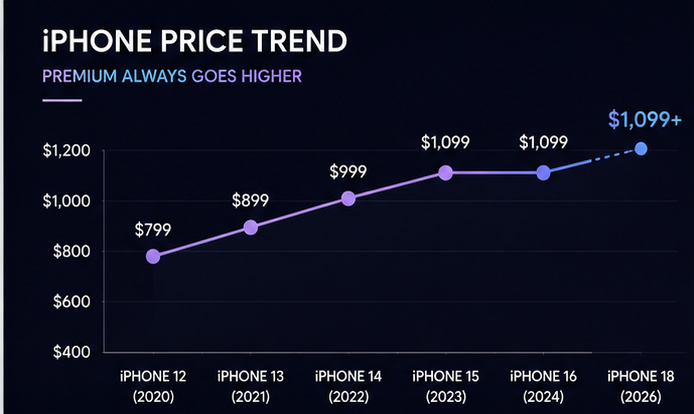
This is where it gets genuinely interesting, because the forecasts don’t all agree — and understanding why they differ tells you a lot about how uncertain even well-informed estimates are this far out from launch.
| Source | Predicted Increase | Resulting iPhone 18 Pro Price |
|---|---|---|
| JPMorgan | ~$50 | ~$1,049–$1,149 |
| IDC | $100–$200 | ~$1,199–$1,299 |
| Counterpoint Research | $150–$200 | ~$1,249–$1,299 |
| TechInsights | Up to $270 (margin-preserving) | ~$1,269–$1,369 |
| Jeff Pu (GF Securities) | $250–$300 | ~$1,349–$1,399 |
Notice the spread: the most conservative estimate (JPMorgan) and the most aggressive one (Jeff Pu) differ by roughly $250 — a genuinely large gap for analysts all looking at broadly the same supply chain data. This tells you something important: nobody actually knows the exact number yet, including the professionals whose job is estimating exactly this. Treat every figure in this article, including the ones getting the most attention in headlines, as an informed guess rather than a locked-in fact.
A More Optimistic Recent Twist
Interestingly, one of the more recent reports — published just over a week before Apple’s expected announcement — suggested the final pricing might land better than the more aggressive estimates implied. Analysts have predicted iPhone 18 Pro pricing starting at $1,299 or $1,399 for the base model, based on rising component costs, but more recent reporting suggests the actual number might undercut those higher estimates.
This lines up with a pattern worth keeping in mind: early-cycle analyst predictions tend to skew toward the dramatic, since a bigger predicted jump generates more attention, while numbers often moderate slightly as an event gets closer and more concrete supply chain data becomes available. Nothing is confirmed either way until Apple’s actual keynote, but it’s a reasonable enough pattern that it’s worth not assuming the highest-end estimate is automatically the correct one.

Why the Standard iPhone 18 Might Be Safer From Price Hikes
Here’s a detail easy to miss in all the Pro-focused headlines: most analysts specifically expect the pricing pressure to concentrate on the Pro and foldable models, not the standard iPhone 18. One report captured this distinction directly, suggesting the standard iPhone 18 may stay relatively stable, while flagship variants push the boundary further.
This tracks with Apple’s historical pattern — the company has generally protected its entry-level flagship pricing even when raising Pro-tier prices, since the standard model is the higher-volume seller and more price-sensitive to begin with. If you’re specifically waiting for the standard iPhone 18 (remember, not expected until spring 2027 per our full release date coverage), this is genuinely one of the more reassuring threads in the entire pricing conversation.
The Foldable: Already Priced Like a Luxury Item
None of the uncertainty above really applies to Apple’s first foldable iPhone — every source agrees this will be dramatically more expensive than anything Apple has sold before, expected to launch north of $2,000. We covered this in full in our dedicated iPhone Fold article, but it’s worth repeating in a pricing-focused piece: some Chinese leaker claims have suggested the foldable specifically could see a further 10–20% increase over earlier expectations, though this specific claim is considered especially speculative even by rumor standards.
A Word of Caution on “Leaked Prices”
It’s worth being direct about something most coverage of this topic glosses over: almost none of the “iPhone 18 price leaks” circulating right now are actual leaked retail prices. They’re a mix of analyst forecasts based on component-cost modeling, supply-chain reports, and fan extrapolation — categories of evidence that carry very different levels of reliability, but often get presented with the same confident tone in headlines.
A more accurate (if less exciting) way to describe most of these numbers is “analyst forecast” or “cost-based scenario calculation,” not “leaked price.” Converting a rumored Chinese yuan component cost directly into a predicted US dollar retail price, for example, ignores regional taxes, tariffs, currency conversion, and Apple’s own pricing strategy — all of which can meaningfully change the final number in ways a simple cost calculation can’t predict.
Will a Price Increase Actually Stop People From Buying?
Probably not, based on the data. iPhone demand has remained famously resistant to price changes — a 2026 survey found that 96.4% of iPhone users plan to buy another iPhone, up from 91.9% in 2021, suggesting brand loyalty has if anything strengthened over the past several years, not weakened. Analysts specifically expect the rumored new Siri AI features to keep upgrade demand strong even if prices rise, since many current iPhone owners are reportedly motivated to upgrade for the software experience as much as the hardware.
In plain terms: even a genuine $200–300 price increase is not expected to meaningfully slow down how many people actually buy the iPhone 18 Pro lineup.
What This Means If You’re Deciding Whether to Upgrade
If pricing is a real factor in your decision, here’s how the current predictions should shape your thinking:
- If you own a standard iPhone 17 — you’re likely safer from any price hike, since most pressure is concentrated on Pro and foldable models, and your realistic upgrade window is spring 2027 anyway.
- If you’re set on a Pro or Pro Max — budget for a genuine possibility of $150–300 over current pricing, and treat anything advertised as a “modest” increase as a pleasant surprise rather than the expected outcome.
- If the foldable interests you — price is essentially locked in as a premium, luxury-tier purchase regardless of which exact number Apple lands on; the “will it be affordable” question doesn’t really apply here the way it might for the Pro line.
We broke down the broader upgrade decision — price aside — in our iPhone 18 vs iPhone 17 guide, which is worth reading alongside this if cost is one of several factors you’re weighing.
Frequently Asked Questions
How much will the iPhone 18 Pro cost? Estimates vary by analyst, ranging from roughly $1,049 (JPMorgan’s more conservative forecast) up to $1,399 (Jeff Pu’s higher estimate). The most commonly repeated middle-ground figure across multiple sources sits around $1,299.
Why is the iPhone 18 expected to be more expensive? Rising global memory chip costs, a more expensive variable-aperture camera component, increased RAM across the lineup, and broader semiconductor cost pressures are all cited as contributing factors by multiple analysts.
Will the standard iPhone 18 also get more expensive? Most analysts expect pricing pressure to concentrate on the Pro and foldable models specifically, with the standard iPhone 18 likely to stay relatively stable in comparison — though it isn’t expected to launch until spring 2027 regardless.
How much will the foldable iPhone cost? Every current estimate places it above $2,000, making it the most expensive iPhone Apple has ever released, regardless of how Pro-line pricing specifically shakes out.
Are these actually leaked prices, or just guesses? Almost none of the current figures are genuine leaked retail prices. They’re analyst forecasts based on component cost modeling and supply chain reporting — informed estimates, not confirmed numbers, until Apple’s official September announcement.
Will a price increase affect iPhone 18 sales? Based on historical brand loyalty data, probably not significantly — the vast majority of current iPhone owners report plans to buy another iPhone regardless of price changes, and new AI-driven software features are expected to keep upgrade demand strong.
The Bottom Line
After years of Apple holding the line on iPhone Pro pricing, this genuinely looks like the year that changes — but exactly how much more you’ll pay remains a real open question even among the professionals whose job is predicting it. The safest way to plan financially: budget for something in the $1,199–$1,349 range for a Pro model, treat anything lower as a pleasant surprise, and remember that nothing is final until Apple actually takes the stage in September.
Want the complete picture beyond just pricing? Check out our full iPhone 18 rumor roundup for release date, camera, and design details across the entire lineup.
This article is based on current analyst forecasts and industry reporting as of August 2026. Nothing here is officially confirmed by Apple, and actual pricing may differ from every estimate in this article once announced.
