
iPhone 18 Battery Life: 3 Secret A20 Chip Upgrades Revealed
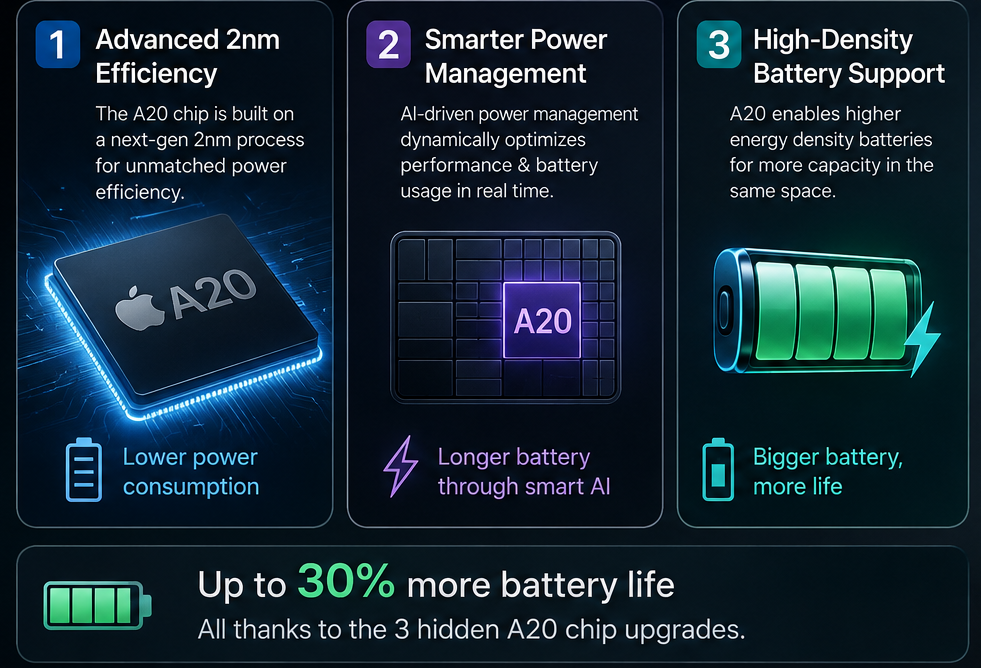
Every iPhone launch has its headline act — this year it’s the foldable, the variable-aperture camera, the eye-watering price predictions. But there’s a quieter story running underneath all of that, one that arguably affects your day-to-day experience more than any single flashy feature: iPhone 18 battery life and A20 chip improvements. If you’ve ever watched your iPhone drop from 100% to 20% during one long gaming session or a day of heavy use, this is the part of the rumor cycle actually worth paying attention to.
We’ve covered the release date, camera, colors, and pricing elsewhere in our iPhone 18 coverage — this piece is dedicated entirely to what’s happening under the hood, because “faster chip” headlines rarely explain what that actually means for how long your phone lasts on a single charge.
The Chip: A20 and A20 Pro, Built on a Genuinely New Process
Every iPhone 18 model — Pro, Pro Max, standard, and even the foldable — is expected to use Apple’s next-generation A20 chip family, built on TSMC’s advanced 2-nanometer manufacturing process. The Pro and Pro Max models are specifically expected to get the more powerful A20 Pro variant.
If “2-nanometer” sounds like abstract marketing language, here’s the plain-English version: it refers to the size of the individual transistors packed onto the chip. Smaller transistors mean more of them fit into the same physical space, which generally unlocks one of two things — more raw performance at the same power draw, or the same performance at meaningfully lower power draw. The genuinely exciting part of this generation is that Apple appears to be leaning into both at once.
According to detailed reporting on the A20’s architecture, compared to TSMC’s previous 3-nanometer process, the new 2nm process is expected to deliver roughly 10-15% better performance at the same power consumption, or alternatively, 25-30% lower power consumption while maintaining the same performance. In practice, this flexibility is exactly why analysts expect this generation’s real-world impact to show up more in battery longevity than in raw speed — most people don’t need a phone that’s dramatically faster than what they already have, but everyone wants a phone that lasts longer between charges.
A New Chip Design: WMCM Explained Simply
Beyond the smaller transistor size, the A20 is reportedly adopting something called WMCM — Wafer-Level Multi-Chip Module — a new way of physically packaging the chip’s components together.
Here’s an easy way to picture it: imagine your phone’s processor, graphics chip, RAM, and AI processing unit used to live in separate rooms of the same building, each needing to send messages down the hallway to talk to each other. WMCM effectively knocks down those walls and puts everything into one single, tightly integrated room. The result is shorter physical distances for data to travel between components, which reduces latency and can also reduce the phone’s overall storage footprint for these components. The most noticeable real-world effect: power-hungry tasks like watching video or gaming — the activities that traditionally drain a phone’s battery fastest — are expected to consume less power on the A20 than on any previous generation chip.
How Much Bigger Is the Actual Battery?
This is where the rumor mill gets refreshingly specific, if a little inconsistent between reports — which is actually a good sign this deep into the cycle, since it usually means multiple independent sources are picking up genuine regulatory filing data rather than pure guesswork.
iPhone 18 Pro: Early 2026 rumors suggested only a slightly larger battery than the iPhone 17 Pro. More recent reporting from mid-2026 has pointed to a more specific figure: a 4,288mAh battery for US units, with a slightly smaller 4,056mAh variant expected for the Chinese market (a common regional difference tied to local battery safety and import regulations).
iPhone 18 Pro Max: Regulatory filing leaks have pointed to notably larger figures here — 5,391mAh and 5,567mAh battery variants have both surfaced in different reports, though real-world capacity and actual endurance won’t be confirmed until Apple officially announces the model and independent reviewers get hands-on testing time.
Worth flagging directly: a physically larger battery isn’t actually the main story here. Multiple sources emphasize that meaningful battery life improvement is expected even without a dramatically larger cell, purely because the 2nm A20 chip does the same work using less energy. This is a more sustainable kind of improvement than simply cramming a bigger battery into the same size phone — it’s an efficiency gain that compounds every time you use the device, not a one-time capacity bump.
What This Actually Means for Your Daily Use
Translating the technical rumors into practical terms, here’s what a genuinely more efficient chip and larger battery combination could mean if the rumors hold:
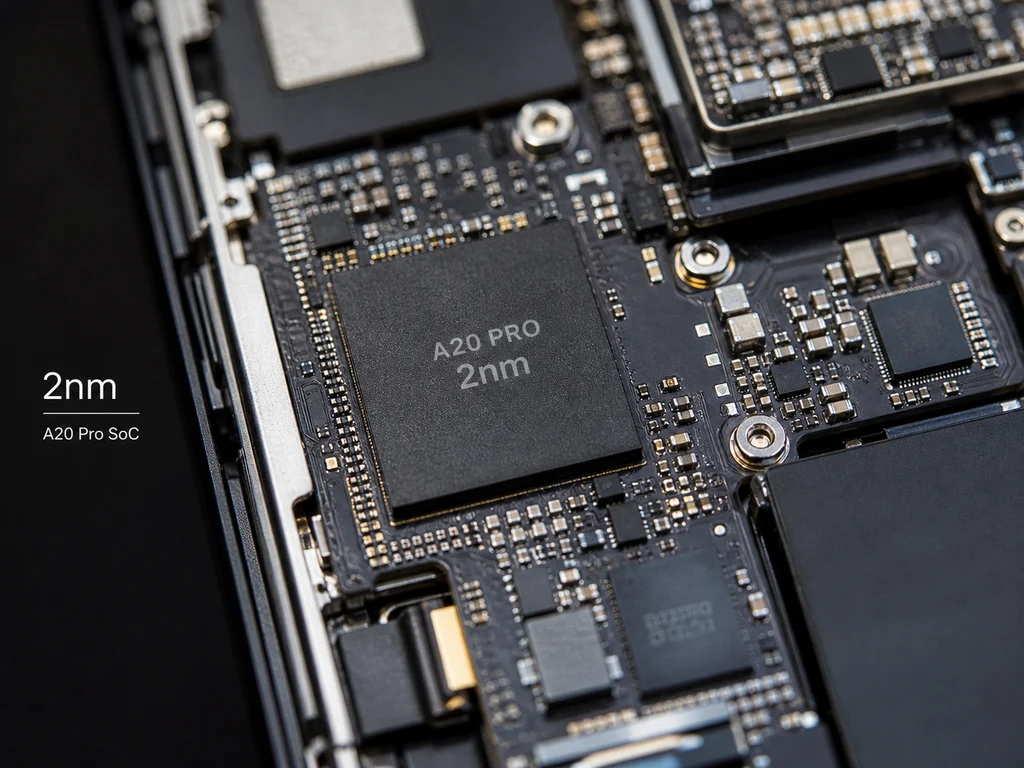
Longer gaming sessions without the drain. Current iPhone 17 Pro users report noticeable battery drain during intensive gaming sessions after roughly 30 minutes of continuous play, often accompanied by thermal throttling that reduces performance to manage heat. The A20’s improved efficiency and heat management are expected to help maintain consistent frame rates for longer sessions while also extending overall battery runtime during exactly this kind of demanding use.
Smoother on-device AI without a battery penalty. With Apple’s major Siri overhaul — now confirmed to be powered by Google Gemini as part of iOS 27 — pushing more AI processing directly onto the device itself, a more power-efficient chip becomes less of a nice-to-have and more of a necessity. Reports specifically point to enhanced AI multitasking capability without the corresponding battery cost you’d expect from that much additional background processing.
Real gains during heavy creative tasks. Activities like 4K video editing, which push a phone’s processor and GPU hard for extended periods, are specifically cited as a use case where users should notice a longer real-world battery runtime compared to the current generation.
An Especially Speculative Rumor Worth Knowing About
Here’s one worth flagging clearly as more speculative than everything above: some reporting suggests Apple may be developing an entirely new type of silicon-based battery for the iPhone 18 — a battery chemistry that doesn’t currently exist in any shipping smartphone from any manufacturer. Some coverage has tied this rumor to the symbolic timing of the iPhone’s 20th anniversary, framing it as a signature technology leap for a milestone generation.
Whether this actually makes it into a shipping product remains a genuinely open question, and it’s worth treating with real skepticism until more sources corroborate it — introducing a completely new battery chemistry into a mass-produced flagship product would be an unusually bold move even by Apple’s standards. If true, though, it would represent a far bigger leap than the more incremental (but still meaningful) efficiency gains already discussed above.
What About RAM? The One Genuinely Unsettled Number
Unlike most of the chip story, RAM capacity for the iPhone 18 Pro lineup remains a real point of disagreement between two of the most closely followed Apple analysts. Ming-Chi Kuo has suggested 9GB of RAM — a modest 1GB increase over the iPhone 17’s 8GB — while analyst Jeff Pu has instead pointed to a more substantial jump to 12GB.
More RAM generally helps with keeping more apps running smoothly in the background simultaneously and can meaningfully affect how well a device handles the growing on-device AI workloads Apple is pushing with iOS 27. Until Apple’s actual announcement, treat any specific RAM figure you see — including both numbers above — as one analyst’s informed estimate rather than a settled fact.
Software Matters Too: iOS 27’s Own Battery Improvements
It’s worth remembering that battery life isn’t purely a hardware story. Some reporting specifically suggests iOS 27 itself is expected to include software-level improvements aimed at squeezing more battery life out of iPhones generally — a pattern Apple has followed in previous years, where a new iOS version brings incremental power management improvements independent of any new hardware. This means even current iPhone 17 owners who don’t upgrade may see some modest battery life improvement once iOS 27 rolls out, separate from anything specific to the iPhone 18’s new chip.
Chip Comparison: iPhone 17 Pro vs. Rumored iPhone 18 Pro
| Spec | iPhone 17 Pro (Current) | iPhone 18 Pro (Rumored) |
|---|---|---|
| Chip | A19 Pro | A20 Pro |
| Manufacturing process | 3nm (TSMC) | 2nm (TSMC) |
| Chip packaging | Traditional | WMCM (Wafer-Level Multi-Chip Module) |
| Power efficiency gain | — | ~25-30% lower power draw at same performance |
| Performance gain | — | ~10-15% faster at same power draw |
| RAM | 8GB | 9GB (Kuo) or 12GB (Pu) — disputed |
| Battery (Pro, US) | Smaller capacity | ~4,288mAh (rumored) |
| Battery (Pro Max, US) | Smaller capacity | 5,391-5,567mAh (rumored, disputed) |
Does This Matter for the Standard iPhone 18 Too?
Yes, arguably even more so. Since the standard iPhone 18 isn’t expected until spring 2027 (as we covered in our full release date breakdown), it will still use the same fundamental A20 chip architecture and 2nm process as the Pro models launching this September — meaning standard model buyers should see similar underlying efficiency benefits, even if the exact battery capacity and RAM configuration end up being less generous than the Pro lineup’s.
Should Battery Life Change Your Upgrade Decision?
If you’re weighing whether to upgrade from an iPhone 17, and you specifically find yourself charging multiple times a day or worrying about battery percentage during long gaming or editing sessions, this is genuinely one of the more compelling practical reasons to consider it — arguably more relevant to daily life than the camera or color rumors, since it affects literally every single day of ownership rather than specific shooting scenarios.
We broke down the complete upgrade decision, weighing this against the camera and design changes, in our iPhone 18 vs iPhone 17 guide — worth reading alongside this if battery life is one of several factors in your decision.
Frequently Asked Questions
How much better will iPhone 18 battery life actually be? Specific figures aren’t confirmed, but the combination of a more efficient 2nm A20 chip and a modestly larger battery is expected to meaningfully improve real-world battery life, particularly during demanding tasks like gaming and video editing, even without a dramatically bigger battery cell.
What is the A20 chip built on? The A20 and A20 Pro are expected to be built on TSMC’s 2-nanometer manufacturing process, a more advanced technology than the 3nm process used in the current A19 Pro, offering roughly 10-15% better performance or 25-30% better power efficiency depending on how it’s configured.
Will the iPhone 18 have a bigger battery? Rumors point to modest to moderate battery capacity increases — around 4,288mAh for the Pro model in the US, and between 5,391mAh and 5,567mAh for the Pro Max, though these figures come from leaked regulatory filings and aren’t officially confirmed.
How much RAM will the iPhone 18 Pro have? This remains disputed between analysts — Ming-Chi Kuo suggests 9GB, while Jeff Pu believes it will be 12GB. Neither figure is confirmed until Apple’s official announcement.
Is Apple really working on a new type of battery technology? There’s a speculative rumor about a silicon-based battery chemistry that doesn’t currently exist in any shipping smartphone, possibly tied to the iPhone’s 20th anniversary. This is considered one of the less certain rumors in the current cycle and should be treated with extra skepticism until more sources confirm it.
Will the standard iPhone 18 get the same chip improvements as the Pro? Yes — the standard iPhone 18, expected in spring 2027, is anticipated to use the same fundamental A20 chip architecture and 2nm manufacturing process, meaning similar underlying efficiency benefits even if exact specs differ from the Pro lineup.
The Bottom Line
While the foldable and the camera are dominating headlines, the A20 chip’s efficiency gains might end up being the change that actually affects your day-to-day experience the most. A phone that simply lasts longer without you thinking about it is a harder story to put on a marketing poster than a folding screen — but it’s arguably the upgrade you’ll actually notice every single day, long after the initial excitement about new colors or camera features fades.
Want the complete picture beyond just battery and chip performance? Check out our full iPhone 18 rumor roundup for release date, camera, design, and pricing details across the entire lineup.
This article is based on current rumors and industry reporting as of August 2026. Nothing here is officially confirmed by Apple, and details may change before the actual announcement.
